


K-Rain Irration Equipment: A Complete Guide to Efficient Landscape Watering
A healthy lawn and thriving garden need consistent watering, but manual irrigation can be time-consuming, inefficient, and expensive. The right irrigation system helps deliver water evenly, reduce waste, and keep plants healthy throughout the year. This is why many homeowners, landscapers, and commercial property managers choose K rain irrigation equipment for reliable landscape watering.
K-Rain offers a wide range of irrigation products, including sprinkler heads, rotary sprinklers, controllers, valves, and accessories. These components can be used to create irrigation systems for residential lawns, gardens, sports fields, parks, and commercial landscapes.
In this guide, we will explore the main types of K-Rain irrigation equipment, their advantages, installation considerations, and maintenance requirements.
What Is K-Rain Irrigation Equipment?
K rain irrigation equipment refers to the collection of watering products manufactured by K-Rain Manufacturing. The brand is known for developing irrigation solutions designed to improve water distribution, simplify system adjustment, and support long-term landscape health.
A complete K-Rain irrigation system may include:
- Pop-up spray heads
- Rotary sprinklers
- Gear-drive rotors
- Irrigation valves
- Automatic controllers
- Rain sensors
- Nozzles and replacement parts
- Swing joints and installation accessories
Each product has a specific role. Sprinkler heads distribute water across defined areas, valves control water flow, and controllers automate the watering schedule. When these components work together, they create a practical and efficient irrigation system.
Main Types of K-Rain Irrigation Equipment

K-Rain produces equipment for different landscape sizes and watering requirements. Choosing the right product depends on the area being irrigated, soil conditions, water pressure, plant type, and available budget.
K-Rain Spray Heads
Pop-up spray heads are commonly used for small lawns, flower beds, narrow planting areas, and residential landscapes. They remain below ground when inactive and rise above the surface when the irrigation system turns on.
Spray heads are useful when an area requires short-range, consistent coverage. They can be fitted with different nozzles to control the spray pattern, distance, and flow rate.
When installing spray heads, it is important to use head-to-head coverage. This means that each sprinkler should distribute water far enough to reach the next sprinkler. Proper spacing helps prevent dry areas and reduces uneven plant growth.
K-Rain Rotary Sprinklers
Rotary sprinklers use rotating streams of water to provide wider coverage than standard spray heads. They are suitable for medium-sized lawns, landscaped areas, and zones where slower water application is beneficial.
Because rotary sprinklers usually apply water more slowly, they can help reduce runoff on sloped or compacted soil. Their rotating pattern also allows water to be distributed across a larger area with fewer sprinkler heads.
K-Rain rotary sprinklers are available with adjustable arcs and radius settings. This makes it possible to direct water toward the landscape while avoiding driveways, walls, sidewalks, and other unwanted areas.
K-Rain Gear-Drive Rotors
Gear-drive rotors are designed for large lawns, sports fields, parks, and commercial landscapes. They can cover considerable distances and are often installed with underground piping for a clean, professional appearance.
A rotor irrigation zone may include adjustable rotation from a partial arc to a full circle. This flexibility allows installers to match the sprinkler pattern to the shape of the landscape.
Rotors are particularly useful for large open areas because they can provide effective coverage with fewer sprinkler heads. However, they require proper water pressure and careful system design to perform correctly.
K-Rain Irrigation Controllers
An irrigation controller, sometimes called a timer, manages when and how long the system operates. It is one of the most important components of an automatic irrigation system.
K-Rain controllers can help property owners create watering schedules based on:
- Start times
- Watering days
- Run time per zone
- Seasonal requirements
- Different plant needs
A well-programmed controller prevents unnecessary watering and helps maintain a consistent schedule. Some advanced controllers may also support sensor integration or weather-based adjustments, depending on the model and installation setup.
Instead of watering every area for the same amount of time, users can assign different schedules to lawns, gardens, shrubs, and shaded zones.
Benefits of Using K Rain Irrigation Equipment

Efficient Water Distribution
A properly designed K-Rain system distributes water across the intended area with fewer dry spots and less overspray. Correct nozzle selection and sprinkler placement are essential for achieving uniform coverage.
Reduced Water Waste
Automatic scheduling and adjustable sprinkler patterns can reduce overwatering. Water is applied according to the needs of each zone instead of relying on manual hose watering or fixed routines.
Water-efficient irrigation is especially valuable in regions where water conservation is important or seasonal restrictions apply.
Improved Plant Health
Plants benefit from consistent and predictable moisture. Regular irrigation can support stronger root development, healthier turf, and more attractive flower beds.
However, efficient irrigation does not mean watering as frequently as possible. The correct schedule depends on climate, soil type, plant species, and seasonal weather conditions.
Convenient Automatic Operation
An automatic irrigation system saves time and reduces the need for daily manual watering. Once the controller is programmed, the system can operate according to a planned schedule.
This is particularly helpful for large properties, vacation homes, commercial areas, and landscapes that contain multiple irrigation zones.
Flexible Installation Options
K-Rain equipment can be used in different applications, from small residential gardens to large commercial landscapes. Components can be combined based on the size and shape of the area.
This flexibility allows installers to create systems that are simple for homeowners or more advanced for professional landscape projects.
How to Choose the Right K Rain Irrigation Equipment
Selecting the right irrigation components requires more than choosing a sprinkler based on appearance or price. Start by evaluating the landscape and water supply.
Measure the Irrigation Area
Record the dimensions and shape of the lawn or garden. Separate the landscape into zones based on plant type, sun exposure, and watering requirements.
Small planting beds may need spray heads, while large open lawns may be better suited to rotary sprinklers or rotors.
Check Water Pressure and Flow
Every irrigation system depends on sufficient water pressure and flow. If too many sprinklers operate in one zone, the system may produce weak coverage.
A professional installer can test the available water supply and calculate how many sprinkler heads each zone can support.
Consider Soil Type and Slope
Sandy soil drains quickly and may require shorter, more frequent watering cycles. Clay soil absorbs water slowly and may experience runoff if too much water is applied too quickly.
Sloped areas also need careful planning. Rotary sprinklers or shorter cycle times can help reduce runoff and improve absorption.
Match the Equipment to the Landscape
Use adjustable sprinkler patterns near sidewalks, fences, and buildings. Select equipment with the appropriate spray radius and arc for each zone.
Avoid installing high-output sprinklers in small areas, as this can lead to excessive water use and overspray.
Installation Tips for K-Rain Irrigation Systems
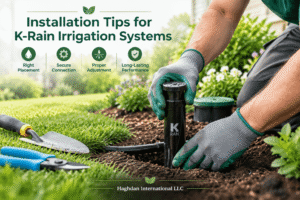
Professional installation can provide the best results, but understanding the basic process is useful for every property owner.
First, create a layout showing the location of pipes, valves, sprinkler heads, and the controller. Divide the property into zones according to water demand and available flow.
Install sprinkler heads at suitable spacing to achieve even coverage. They should generally be positioned level with the soil surface and protected from lawn equipment.
Use quality fittings and ensure that all connections are secure. Leaks in underground pipes or fittings can waste water and reduce system performance.
After installation, test every zone. Check for blocked nozzles, incorrect spray direction, leaks, and areas that receive too much or too little water. Adjust the sprinkler heads before programming the final watering schedule.
Maintenance Tips for K Rain Irrigation Equipment
Regular maintenance keeps an irrigation system efficient and extends the life of its components.
Inspect sprinkler heads regularly for damage, dirt, or grass obstruction. Clean blocked nozzles and replace broken components when necessary.
Check the system for leaks, especially around valves and exposed connections. A sudden increase in water usage may indicate an underground leak.
Adjust sprinkler patterns as plants grow or landscape features change. Make sure water is not spraying onto sidewalks, driveways, walls, or other areas that do not need irrigation.
The controller should also be reviewed throughout the year. Watering requirements often change between spring, summer, autumn, and winter. Reducing run times during rainy periods can prevent overwatering.
If the system is installed in an area exposed to freezing temperatures, follow the appropriate winterization process. This may include shutting off the water supply and removing water from pipes to reduce the risk of damage.
Final Thoughts
Investing in K rain irrigation equipment can make landscape watering more consistent, convenient, and efficient. From compact spray heads to large-area rotors and automatic controllers, K-Rain provides components for a wide variety of irrigation applications.
The best results come from choosing equipment based on the landscape layout, water pressure, soil type, and plant requirements. Proper installation, accurate controller programming, and regular maintenance are equally important.
Whether you are upgrading a home lawn or designing a commercial irrigation system, a well-planned K-Rain solution can help conserve water while supporting a healthier and more attractive landscape.