


How to Reduce Agricultural Water Consumption Through Advanced Irrigation and Soil Management
Water is the fundamental lifeblood of all agriculture. With global populations steadily rising, agricultural demands increasing, and climate patterns becoming increasingly unpredictable, securing a reliable water supply for farming has never been more critical. Currently, agriculture accounts for roughly 70 percent of global freshwater usage. This staggering statistic brings us to one of the most pressing questions in modern farming: how to reduce agricultural water consumption without sacrificing crop yield, plant health, or harvest quality.
Addressing this monumental challenge is not just an environmental imperative; it is a vital economic necessity for farmers worldwide. For those wondering how to reduce agricultural water consumption effectively, the answer lies in a combination of advanced irrigation technologies, biological soil management, and strategic operational planning. In this comprehensive guide brought to you by Haghdan International, we will explore practical, proven, and sustainable strategies to help agricultural professionals optimize their water management systems, stay informed on modern methodologies, and protect their bottom line.
Why Knowing How to Reduce Agricultural Water Consumption is Essential

Before diving into specific technological solutions and field practices, it is highly important to understand the broader impact of water conservation. Traditional farming methods, such as flood or furrow irrigation, are notorious for their severe inefficiency. Much of the water applied in these older methods is permanently lost to rapid surface evaporation, deep soil percolation, or uncaptured runoff long before it ever has a chance to reach the plant roots.
When farm managers actively research how to reduce agricultural water consumption, they are essentially future-proofing their entire operations against unpredictable weather patterns and regulatory water restrictions. Efficient water management goes far beyond just saving liquid resources. Furthermore, understanding how to reduce agricultural water consumption leads to better nutrient retention in the topsoil, minimizes devastating soil erosion, and drastically lowers the massive energy costs associated with pumping, filtering, and distributing water across hundreds of acres. Adopting sustainable practices ensures that valuable farmland remains viable and profitable for future generations while adapting seamlessly to the new realities of climate change.
Practical Methods: How to Reduce Agricultural Water Consumption
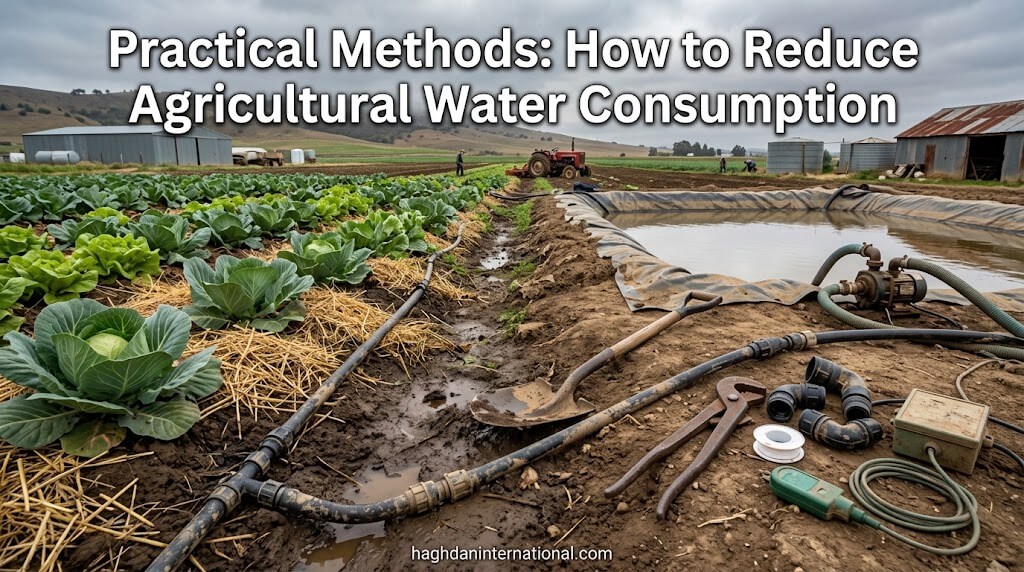
Successfully minimizing water waste requires a dedicated, holistic approach that combines modernized irrigation methods, smart soil management techniques, and strategic crop planning. Below are the most effective and actionable strategies you can implement on your farm today.
1. Transition to Precision Drip Irrigation Systems
One of the most direct answers to how to reduce agricultural water consumption is moving away from outdated surface irrigation techniques and fully embracing precision systems. Drip irrigation and micro-sprinkler systems are scientifically designed to deliver water directly to the plant’s active root zone at a highly controlled rate.
Unlike traditional methods that blanket an entire field in excess water, precision irrigation ensures that every single drop is utilized efficiently by the crop. By slowly applying water exactly where and when it is needed, farmers can reduce surface evaporation and runoff to near zero. Furthermore, these targeted systems keep the crop foliage dry, which naturally decreases the likelihood of devastating fungal diseases and subsequently reduces the need for expensive chemical interventions.
2. Implement Smart Soil Moisture Management
Soil health and water conservation go hand-in-hand in any successful farming operation. If the soil structure cannot retain moisture effectively, even the most technologically advanced irrigation system will fall short of its potential. Another fundamental aspect of how to reduce agricultural water consumption naturally is through physical soil moisture retention techniques.
Applying a thick layer of mulch—whether utilizing organic materials like straw and composed green waste, or employing engineered agricultural plastic mulch—acts as a powerful protective barrier over the vulnerable soil. Mulch drastically reduces surface evaporation caused by sun and wind, suppresses water-stealing weeds that compete with your crops, and helps regulate extreme soil temperatures. Additionally, planting specialized cover crops during the off-season helps improve the underlying soil structure, allowing it to act like a giant natural sponge.
3. Utilize Soil Moisture Sensors and IoT Data
Modern farming is rapidly becoming a highly data-driven science. Guesswork in irrigation scheduling often leads to severe overwatering, which not only wastes precious resources but can also suffocate plant roots and leach vital fertilizers deep away from the root zone. To truly master how to reduce agricultural water consumption, modern agriculture utilizes smart soil moisture sensors placed at varying strategic depths throughout the field.
These innovative devices provide highly accurate, real-time data on exactly how much water is present in the soil at any given moment. By integrating these field sensors with smart IoT (Internet of Things) controllers, farmers can schedule their irrigation precisely when the crop actually needs it, rather than adhering to an arbitrary or rigid timed schedule. This data-driven approach eliminates water waste entirely and promotes vastly healthier root development.
4. Optimize Crop Selection and Rotation Planning
It is a well-known agricultural fact that not all crops have the same water requirements. A strategic approach regarding how to reduce agricultural water consumption involves selecting crop varieties that are naturally bred and suited to the specific local climate and historical rainfall patterns.
Drought-tolerant crops, or specific seed varieties engineered to thrive with minimal water input, can drastically lower a farming operation’s overall water footprint. Additionally, practicing intelligent, multi-year crop rotation helps break destructive pest and disease cycles while simultaneously improving overall soil health. Rich, healthy soil requires significantly less supplemental water to support robust, deep root systems.
5. Prioritize System Maintenance and Leak Detection
Even the most expensive and technologically advanced irrigation system can become a massive liability if it is not properly and consistently maintained. When assessing how to reduce agricultural water consumption across a large commercial farm, routine inspections of all water infrastructure are absolutely crucial. A surprising and unacceptable amount of agricultural water is lost annually simply due to undetected subterranean leaks, broken micro-emitter heads, or degraded mainline pipes.
Checking heavy-duty pumps, pressure valves, physical filters, and delicate delivery lines at the start of the planting season—and continuing inspections periodically throughout the growing months—ensures the entire system operates at peak efficiency. Regular preventative maintenance saves massive amounts of water over time.
6. Implement Rainwater Harvesting and Runoff Recovery
As a highly effective supplemental method for how to reduce agricultural water consumption, capturing and storing water that would otherwise be lost to the surrounding environment is an excellent long-term strategy. Many modern, forward-thinking farms actively construct large catchment basins, collection ponds, or specialized underground tanks to capture heavy seasonal rainfall and redirect agricultural surface runoff.
While setting up a comprehensive water recovery system requires initial architectural planning and earthmoving groundwork, it ultimately creates a highly valuable, free reserve of water. This stored resource can be continuously recycled and safely utilized during unexpected dry spells.
Conclusion
Understanding how to reduce agricultural water consumption is a continuous, evolving process of field observation, technological adaptation, and operational improvement. There is no single magic solution, but rather a combination of smart, integrated practices. From adopting precision drip irrigation technology and implementing protective soil mulching, to utilizing smart field sensors and keeping up with rigorous routine maintenance, every single operational step makes a tangible difference.
Anyone looking into how to reduce agricultural water consumption must remember that sustainability is an investment in the future. By applying these proven strategies, agricultural professionals can immediately optimize their operational resources, deeply protect their local ecosystems, and build highly resilient, productive farms. Sustainable water management is not just a passing industry trend; it is the definitive, essential path forward for the survival and profitability of global agriculture.